

What is pad printing on Hasami ware? The decoration process seen during factory tours.

The process of creating Hasami-yaki pottery involves various stages, such as shaping, painting, glazing, and firing.
At Takayama, the factory work begins once the bisque-fired vessels arrive.
Last time, we introduced the "dusting" process, which involves removing dust and fine particles from the surface of the unglazed ware.
This time, we will introduce a process called "pad printing," used to apply patterns to the vessels.
| What is pad printing?

Pad printing is a technique that uses a soft pad to transfer a design onto the surface of a vessel.
Vessels do not always have flat surfaces; they often feature rounded areas or curves. Consequently, many shapes are difficult to print on using standard flat-printing methods.
With pad printing, a soft silicone pad conforms to the shape of the vessel upon contact, allowing the design to be applied even to curved surfaces.
Another key feature is the ability to print the same design onto multiple vessels, ensuring a consistent finish.
| An important step in adding patterns to the vessel.

Pad printing is a process that significantly influences the overall impression of the vessel.
The character of the finished piece changes depending on the placement and density of the lines, as well as how the pattern appears.
For this reason, each piece is printed with great care, while the position of the vessel is constantly monitored during the process.
At first glance, it might appear to be a simple mechanical printing task, but in reality, adjustments must be made to account for the vessel's shape and the specific placement of the pattern.
Even when producing identical vessels, visual checks by the human eye—alongside the machine's operation—are essential to ensure a consistent finish.
| Expanding Design Possibilities with Pad Printing
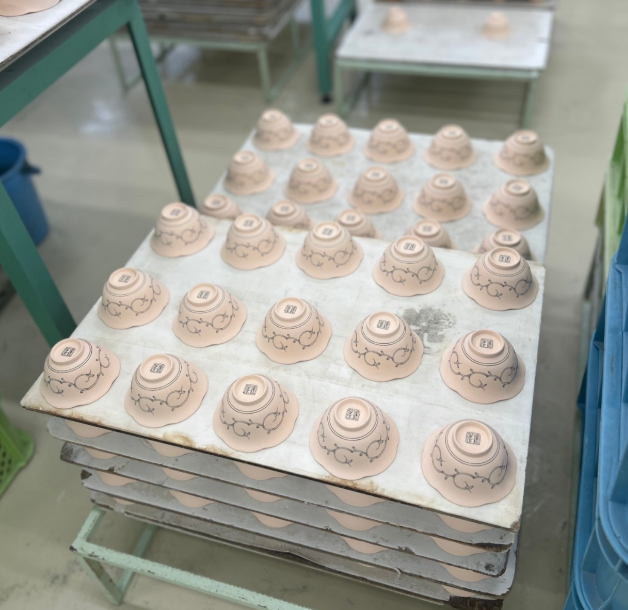
Pad printing is also used to render fine lines and repeating patterns.
It accommodates a wide range of designs, from simple accent motifs to patterns that define the overall character of the vessel.
Hasami ware is cherished for its suitability for everyday dining. Within this context, pad printing is a key technique for balancing usability with aesthetic appeal.
The final impression can vary significantly—even with the same production process—depending on the combination of the vessel's shape, the pattern, and the colors used.
| A scene of manufacturing taking place in a factory.
At the Takayama factory, pad printing is performed to match the shape and design of each vessel.
The vessel is placed in a specific position, and the design is transferred onto it using a pad. Through the accumulation of these individual steps, patterns are gradually applied to the vessel.
The printed design is then set onto the vessel's surface through subsequent processing stages.
While it may be difficult to discern when looking only at the finished product, it is precisely these processes on the manufacturing floor that create the unique character of the vessel.
| Hasami-yaki manufacturing process viewed during a factory tour

At Takayama, we offer factory tours where you can observe the manufacturing process of Hasami ware.
By watching the actual work, you can gain a firsthand understanding of the flow of pottery making and the role of each step in creating the tableware you use every day.
The pad printing method introduced here is one of the decorating processes used to apply patterns or designs to the ware.
It is one of the most accessible parts of the factory tour, as it allows you to clearly see exactly how the patterns are applied to the pottery.
| summary
Pad printing is a technique that uses a soft pad to transfer a design onto the surface of a piece of pottery.
It allows patterns to be applied even to curved surfaces and is a crucial step in ensuring a consistent, high-quality finish.
The final look of a piece depends not only on the design itself but also on how that pattern is applied to the vessel.
At a Hasami-yaki factory tour, you can see this production process up close.
We invite you to witness the creation process firsthand and experience the unique appeal of Hasami-yaki craftsmanship.


Comments