
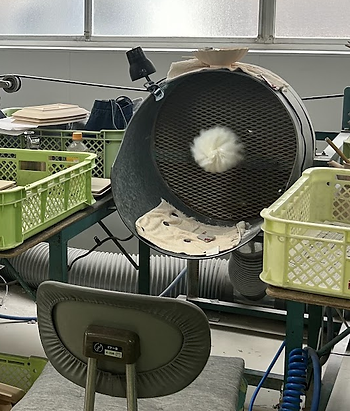
Hawaki (Surface Cleaning)
Hawaki (Surface Cleaning)
At Takayama, the production process begins as soon as the bisque-fired pottery arrives.
The first step is to thoroughly clean the surface of each piece by using an electric feather duster to remove any dust or fine particles.
This careful preparation ensures that both paint and glaze adhere evenly, resulting in a smooth, beautiful finish.

Pad Printing
Pad Printing
One of our specialties is pad printing - a technique where ink from a resin plate is transferred onto a silicone pad, then pressed onto the surface of the piece.
This method allows us to achieve a hand-painted look, with subtle gradients and a rich depth of color that brings each design to life.

Painting
Painting
Fine details that cannot be reproduced through pad printing are painted by hand using a brush.
We use techniques such as sujibiki, which creates delicate fine lines, and fuchisabi, a decorative finish applied to the rim.
We also hand-apply color to small human-shaped decorative motifs known as ikkanjin.

Glaze
Glaze
After the designs are painted onto the vessels, they are coated with glaze to seal and protect the surface. Next, each piece is placed onto a sponge conveyor belt moistened with water, where the glaze is carefully removed from the foot (the bottom) of the vessel. Removing the glaze from the foot prevents the melted glaze from sticking to the kiln during firing.
Note: Various types of glaze are used, including those that become transparent after firing, produce vibrant colors, have a smooth, glossy finish, or a matte texture -offering a wide range of surface qualities.

Robat Arm
Robat Arm
After the designs are painted onto the vessels, they are coated with glaze to seal and protect the surface. Next, each piece is placed onto a sponge conveyor belt moistened with water, where the glaze is carefully removed from the foot (the bottom) of the vessel. Removing the glaze from the foot prevents the melted glaze from sticking to the kiln during firing.
Note: Various types of glaze are used, including those that become transparent after firing, produce vibrant colors, have a smooth, glossy finish, or a matte texture -offering a wide range of surface qualities.
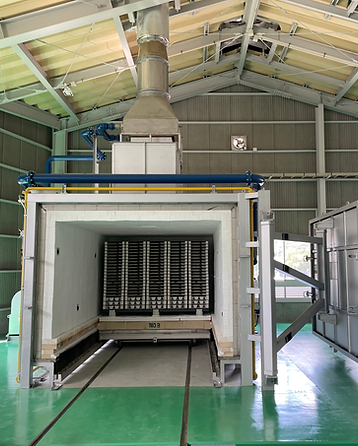
Kiln
The pieces are loaded into the kiln for the final firing process. Takayama’s kiln operates at 1,270°C, with a firing time of about 10 hours followed by approximately 12 hours of cooling.
Note: During firing, the glaze melts and forms a glass-like coating on the surface of the pieces. This process enhances their appearance, seals the surface (making the piece waterproof), and increases the strength of each piece.
◇ Approximately 3,000 pieces can be fired in a single kiln load (one day), though this number varies depending on the type and size of each piece.

Smoothing the Foot
Smoothing the Foot
After firing, the foot (base) of each vessel is carefully polished.
This process smooths the surface to prevent scratches on tables and to improve the feel when handled.

Inspection
Inspection
Each finished piece of pottery is individually hand-inspected for quality. We carefully check for issues such as uneven color, small flaws, or cracks. Any piece that does not meet our quality standards is removed from the production line. Once the inspection is complete, approved pieces are ready to be shipped across the country.
In addition to supplying wholesale distributors and retail partners, our products are also sold directly through our own stores.